click here for Part 1
I woke up next morning in my tent with a distinct feeling that I was on holiday. A feeling that quickly dissipated when I poked my head out and realised that my car - which I'd been half expecting to be parked next to the tent - was not there.
It was Monday morning in September. The sun was shining brightly after the morning mist dissipated. A beautiful day, but I was dreading confronting the reality of the situation I was in.
Mindful of my friend's schedule, I asked him what time he could get me back to my stranded car, sitting in some random village 20km away. He said he'd be happy to take me there, but first he had to go for a surf in the morning. Couldn't blame him. After all, it wasn't his fault I'd got myself into this mess.
As he prepared to head out, I was busy scheming on how to get my hands on a car charger. I looked around the campsite. Late season meant few people, but I noticed a big RV parked not far away. Plugged in. Maybe, just maybe, I thought, the charger these people were using for the RV would be the same one I needed to escape my fate.
The Dutch Connection
I knocked on the door beneath the canopy. A nice Dutch man in his 60s with a strong accent answered. I explained what I was looking for. After giving me a puzzled look, he ducked back into his mobile home and came out with a key.
'I have a box full of random stuff,' he said. 'Maybe I have it in there. Let me check.'
He rummaged through the box and emerged with a charging cable.
For one beautiful second, I felt hope. Then I saw the connector.
Wrong type. For connecting the other way.
Of course it was.
I thanked him, trying hard to hide my disappointment, and walked away with a sigh. Nothing to do here now. When in Rome, do as the Romans. Temporarily wiping the future from my brain, I gestured to my friend that I'd join him in the water, erasing all thoughts of electric cars, charges, dead batteries, and towing, and hit the waves for a couple of hours.
By the time the afternoon heat rolled around, I was getting anxious. My friend was relaxing in his van in an after-surf bliss. Meanwhile, I was pacing up and down under the hot sun, trying to come up with a game plan.
I looked at the map of where my car was stranded. The first thing that popped into my head: there must be some garages. Maybe, just maybe, they'd have a spare charger lying around that I could borrow for a couple of hours. I proceeded to map out all the potential businesses that could in any way, shape, or form be related to either cars, electricity, or some intersection thereof.
It was still early afternoon, though, and this being Portugal, I'd have to wait another hour before they'd reopen from the lunch break. I'd have to call them from the road, as time was getting tight.
When we finally did hit the road, I felt waves of anxiety. But I was also mentally prepared that if I had to spend the next eight hours trying to dig myself out of the hole, then so be it.
The Ford Dealership
As we made our way to that godforsaken village where my car had decided to stop, I was frantically calling every place on my improvised list.
'Olá, boa tarde. Do you have a charger?'
'No, for a car.'
'EV.'
'No, the big fat one.'
'You know anyone who drives an electric vehicle around here?'
'Do you own a fleet of electric vehicles?'
'Não. Desculpe.'
'Não.'
'Obrigado.'
Just as I was losing hope, my friend saw a sign in the distance. 'Looks like there's a Ford dealership ahead on the left,' he said.
'Yeah, let's stop.' At this point I had nothing to lose. Maybe by some miracle they'd have an EV charger around.
I stepped into the shop to ask one of the repair guys if they had one. 'Infelizmente, não,' the guy came back with a disappointed look. 'But let me ask around.'
The mechanic - mid-40s, grease-stained overalls, a relaxed country air about him - leaned against the service bay and started dialling.
'Oi Paolo, tudo bem? Olha, tens um carregador?' A pause. 'Não, para carros. Eléctricos, sabes?'
Now pacing up and down the open bay, he gestured at me with his free hand as if Paolo could see through the phone. Another pause while Paolo apparently asked for clarification.
'Sim, sim, aqueles grandes. Conheces alguém por aí quem disponha?'
'Não. Ah, epá, obrigado então. Até já.'
He worked through four calls like this. Each conversation following the same leisurely Portuguese rhythm.
Here's what you need to understand about Portugal: the systems don't work, but the people try to help anyway. It's almost as if the people try to be helpful to make up for the general chaos of the system. A survival tactic.
It's beautiful and maddening in equal measure.
This guy was spending five minutes of his workday calling random acquaintances to help a desperate foreigner, all whilst a Ford waiting for an oil change sat on the lift behind him.
He hung up the final call and turned to me with a shrug. 'Desculpa. Nobody around here services electric cars. Good luck on the search.'
As I thanked him and stepped out into the afternoon light, I sighed. 'Well, I guess it's going to have to be towing,' already imagining the ride of shame from the parking lot to the charger, with drivers of dirty diesel cars snickering at my predicament.
Just then, as I was heading out to meet my friend in the car park, my imagination manifested a tow truck.
Mustering the courage to admit defeat, I asked the driver if he'd be willing to tow me. 'Sinto-me,' he said. 'I only work with the central office.'
I asked him where, and he replied, 'Figueira.' Da Foz, that is. Which was 40km away from here.
This was going to be more difficult than I'd imagined.
Eppur Si Muove
At this point, I'd exhausted all my options. Time to get back to the scene of the crime, swallow my pride, and call the towing service. Hopefully there was one closer than 50km, and I wouldn't have to pay for them to make the trip, never mind the waiting time.
As we were driving the final stretch towards the scene of my misfortune, I spotted the two chargers that had, alas, been beyond my reach the night before. How close they were, I thought. Had a few things gone differently, I'd be enjoying this beautiful afternoon with a fully charged car. Instead, I was in full anxiety mode.
Momentum veritatis, I mumbled under my breath as I spotted the car park ahead on the left. A bit of relief came over me as I could see the silver outline of the Peugeot in the distance.
As we pulled in, my friend pointed ahead. 'You know, sometimes batteries discharge after a long drive. You might try to start it and see if somehow, after cooling down overnight, you might get a bit more charge out of it.'
I really think he was trying to console me, but why not, I thought. If you don't try, the answer is no.
I slid into the driver's seat, hand trembling slightly as I reached for the ignition. My friend's optimism felt like false hope. Batteries don't just magically recharge overnight. That's not how physics works. But what did I have to lose?
I turned the key. The dashboard lit up.
I pressed the accelerator, barely breathing.
The electric motor hummed to life.
'Eppur si muove!' I shouted out the window. And yet it moves!
My thinking brain shut off. Pure instinct took over. No time to question the miracle or calculate probabilities. Just: go. Now. Before it changes its mind.
I started up the hill, praying I wouldn't get stuck right where the engine had given up the previous day. I made it over on pure adrenaline. As I slowly came down, I saw the shining beacon in the distance. The Intermarché, that is. The one with that lonely charger next to it.
I was so anxious not to make it that I didn't even stop to yield to oncoming traffic to make the left turn into the car park. I opened my window and waved my hand with an imaginary white flag, hoping my emergency flasher lights would explain my predicament. Thankfully, I gingerly descended into the supermarket car park and pulled up next to the charger without the engine dying.
The 404 Error
And now for the second hora veritatis: would I be able to charge the car?
I got out and inspected the charging post. Seemed like everything was in order. The connection for the cable I had was there. But as I looked at the LED display, I noticed there was a problem. 'Please swipe your card or enter your user number,' it said.
Uh-oh.
I don't have either.
Google Maps had indicated it was a public charger and it was available. As had been the leitmotif of my trip so far, reality turned out to be quite different.
My first instinct was to go into the supermarket. As I passed the entrance, I asked customer services how to use the charger. The friendly employee quickly informed me that Intermarché had nothing to do with the charger and that I'd have to call the customer service number written on the side of the post.
I took a deep breath. Staring at the side of the charger, I dialled the number written on the worn plaque. The mechanical voice delivered its verdict in cheerfully bureaucratic Portuguese: 'Lamentamos, mas o número que marcou não se encontra disponível.'
Not giving up yet, I saw there was a website listed under the phone number. I tapped it into my phone.
'404,' the blank screen read.
'Porra da merda!' I punched the LED display. Not my finest moment, but the universe deserved it.
Here's what I want you to appreciate about this moment: I was standing in an Intermarché car park, having just driven my nearly-dead electric car to a 'public' charging station, only to discover that the company responsible for said station had ceased to exist.
The charger wasn't broken. The charger was abandoned.
It was the infrastructure equivalent of a Wild West ghost town, except instead of tumbleweeds there was just me, staring at a 404 error on my phone, whilst my car's battery indicator blinked its last red blinks at me.
This, friends, is what they call 'the energy transition'.
'Merda!' I yelled out again. What five minutes ago had seemed like salvation turned out to be a mirage. I thought I'd made it to the oasis, but I was still in the desert, and my mechanical camel was dying of thirst.
I called my friend, whom I'd left behind without even telling him if I'd made it or not. Turns out he was just behind me in the Intermarché car park. He was just stopping for provisions. Like any normal person on holiday. I wished I could trade places with him at that moment.
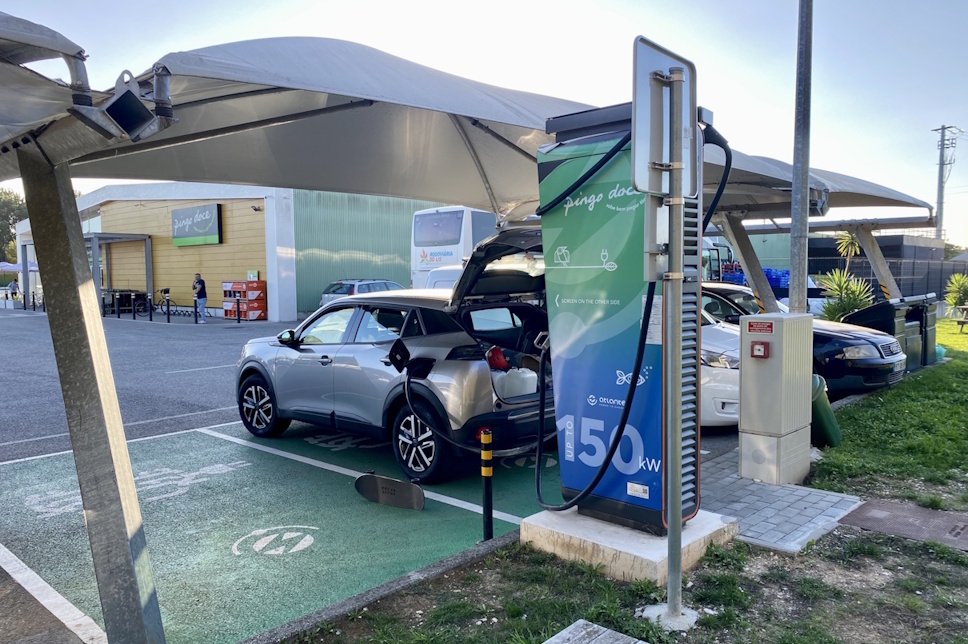
But I had to figure out what to do next. I knew there was another charger about half a kilometre ahead at a Pingo Doce, and I'd seen in passing when we were driving down that there was a car charging there. Yet in my game theory scenario, I'd decided not to take the further risk and had pulled off at the one I was now stuck at. Now that option was gone.
I informed my friend that if he saw me stranded up the road causing a new traffic jam, he'd know what had transpired. At the same time, I was secretly praying I'd hit the jackpot twice.
Lucky for me, as I turned the ignition key and gently pressed the accelerator, the slot machine stopped at 777. The car moved.
The Pilgrims of Pingo Doce
I tried to glide smoothly through the car park and navigate around the other cars without stopping as I pulled onto the main road. To my relief, the car kept going despite the empty charge indicator. I knew, though, that I was driving on borrowed time from some other dimension.
As I came in view of the Pingo Doce, I gently glided into the car park and backed into the space next to the charger. Hardened by my recent experience, I glanced at the LED screen in dread.
'Bem-vindo,' it said.
It's working.
A sigh of relief washed over me. Salvation, at last! My anxiety instantly turned to ecstasy when I realised just what a catastrophe I'd avoided in the previous 20 minutes.
The jubilation quickly faded as I realised I now had to navigate the strange and wonderful world of electric car charging. The first thing I realised was that, unlike the price at the petrol pump, there was no way I could figure out how much I'd actually pay for the charge in advance. Not that I had a choice, frankly. And, of course, there was the question of charging speed.
I connected the cable to the car and confirmed that it was indeed charging.
I looked at the display on the charger. It threw up a QR code demanding that if you wanted your charge information, you sign up at the link. In fairness, I seldom install apps and sign up for random services I might use only once. Something told me, however - perhaps subconsciously - that after my recent experience, I wanted to be extra sure. Good thing I made that gut decision, because after I'd left the car charging for a few minutes and came back to the station, the only way I could see the status was indeed on the phone. And yet I still had no idea how much I was paying.
Let me describe the pricing display for you:
There was a connection charge. Then there was a base rate. There was a peak hour surcharge. There was a fast charging premium. There was something called an activation fee. There were three different prices per kWh depending on... the position of mercury relative to the perihelion of the moon, with a bonus if it was in retrograde. The screen had more numbers than a Powerball ticket.
I have a PhD in ocean engineering. I can calculate wave forces on offshore structures. I once spent three months modelling floating wind platform dynamics in ANSYS ADPL.
I could not figure out how much I was paying to charge my car.
This is not a bug in the system. This is the system.
'Oh well,' I thought. Hopefully it would be cheaper than those exorbitant Portuguese petrol prices. The car dashboard indicated it would take about an hour to charge to full. Not exactly super-fast, but at this point I was so exhausted that I didn't mind taking a break. And to be frank, for a supermarket car park, it wasn't such a bad place to be. Right behind it was a nice grassy slope with some trees in the background and a couple of picnic tables thrown in. The grass looked especially green after the recent rains.
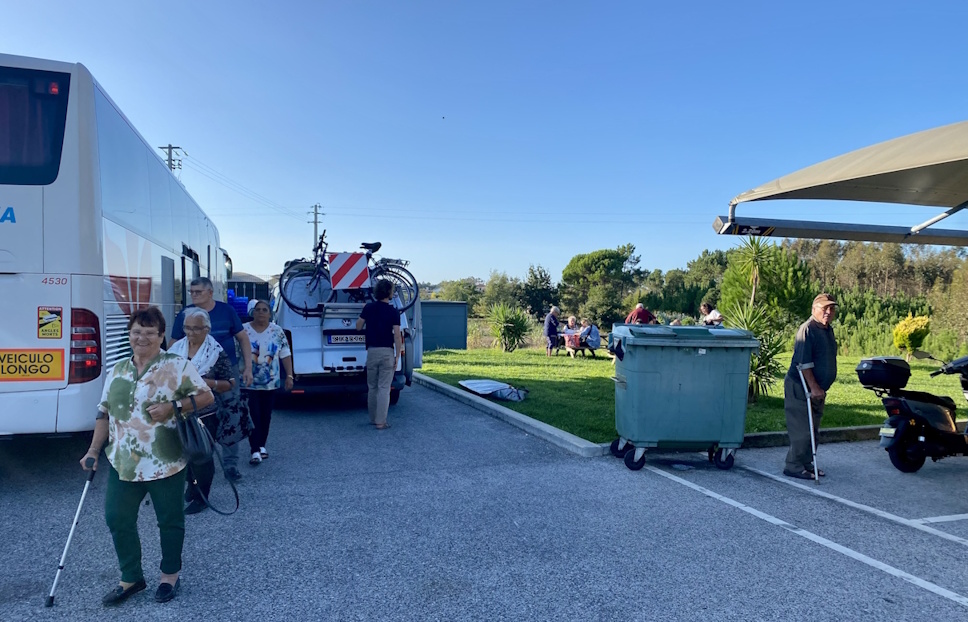
Now that the car was finally charging its battery, it was time to charge mine. I messaged my friend ecstatically, saying I was at last saved, and that he could come over and join me for a picnic whilst I waited for the car to charge. He pulled up a couple of minutes later in his van. Yet just as I was about to take the food out from my car, I noticed two large buses pulling right in front of the charging station and next to my friend, making his large van all of a sudden seem like a toy.
Then the doors opened and the buses disgorged their cargo: about forty pensioners, dressed in sensible shoes and windbreakers. They spread out across the picnic tables with practised efficiency, unpacking thermoses and carefully wrapped sandwiches.
I asked one of the ladies where they were headed.
'Fátima!' she said proudly. 'We're on pilgrimage.'
I watched them settle in with their lunch. These were real pilgrims - not the Instagram-posting, selfie-stick-wielding 'pilgrims' I'd witnessed in Santiago de Compostela. These old people believed. But they were touring sacred sites by motorcoach. Because you can't walk 200 kilometres when you're 75.
I looked at my Peugeot, plugged into the charger, slowly sipping electrons.
We were both pilgrims of a sort, I realised. They were seeking spiritual salvation at Fátima. I was seeking electrical salvation at Pingo Doce. Both dependent on infrastructure that barely worked. Both making the best of a system designed by a higher power beyond our control.
The difference? Their faith was in God. Mine was in the EU charging infrastructure.
I wasn't sure who was more reliant on faith.
The picnic pre-empted, I was anxious to be done charging and to head back to the campsite for a nice dinner. Forty-five minutes later, the battery charge indicated it was almost done, at 375km. 'Just a few minutes more,' I thought. I should quickly run into the supermarket to stock up on a few things.
Much to my chagrin, when I came out 20 minutes later, I saw that it was still showing 390km. I supposed there was an asymptotic limit as to how fast the battery could get to full charge. Getting hungry now, I decided not to wait any more and pulled the plug from the Peugeot.
The Price of Salvation
It was time to figure out how much I'd actually paid. The charger showed nothing. Good thing I'd signed up with that QR code. I got a text message with the bill.
€38.70.
I may not be a mathematician, but it seemed to me like the various prices displayed on the screen didn't exactly sum up to the final result. This would have to be done post-mortem when I got back home. I was left with a sour expression on my face.
€38.70.
Let me put that in perspective for you. The Peugeot's 54kWh battery gave me about 400km of range. My trusty Ford would have needed about 20 litres of petrol for the same distance. At Portuguese petrol prices (€1.70/litre) that's €34.
I'd just paid more to charge an electric car than I would have paid to fill a petrol tank.
All those enthusiastic blog posts about how EVs are 'so much cheaper to run'? Turns out they forgot to mention they were charging at home from their solar panels. Public fast charging in rural Portugal? More expensive than fossil fuels.
Free markets would have solved this if polluters paid their costs and the chargers weren't run by legacy electric providers. Instead, we have the worst of both worlds: expensive clean energy and subsidised dirty energy.
Ouch.
But to be honest, at this point I was just happy I'd been able to avoid disaster and charge the car at all. As I pulled away from the Pingo Doce, I was back in fun mode, fully enjoying the smooth acceleration of the car as I overtook the few slow stragglers on the nearly empty road. As I made it back to the campground - this time on my own four wheels - I resigned myself never to repeat the mistake I'd made. And never to trust the battery level indicator again. Or charger icons on a map - but that's the story for the next installment, Part 3